Healing the Hurt: Meet the Obsessive Craftspeople Bringing Damaged CD Packaging Back From the Dead
There's a copy of Radiohead's Kid A sitting on a workbench in a spare bedroom outside of Columbus, Ohio. It came in rough — the digipak spine was splitting, the interior tray had a hairline crack running through it, and the booklet showed the unmistakable tide-line of water damage along its bottom edge. Most people would toss it. Marcus Delray, 41, sees it as a challenge.
"People think I'm crazy," he says, laughing. "My wife definitely thinks I'm crazy. But when you pull something like this back to the condition it deserves to be in, there's nothing like it. It's like the album gets its dignity back."
Delray is part of a loosely connected underground network of CD packaging restorers — a community that barely has a name, communicates mostly through private Discord servers and niche subreddits, and operates in a corner of collector culture that even hardcore music fans don't know exists. These are the people who fix the things the rest of us give up on. And their work is far more involved than you'd ever guess.
More Than Just Cleaning It Up
Let's be clear about what we're talking about here. This isn't wiping down a jewel case with a paper towel and calling it a day. Full restoration of a damaged CD package can involve archival-grade adhesives, humidity-controlled drying chambers, UV-reactive inks for color matching, and tools borrowed from the worlds of paper conservation and fine art restoration.
Sandra Kowalczyk, a professional paper conservator based in Chicago who moonlights as a CD packaging restorer, explains that the materials involved are genuinely complex. "Digipak board is a nightmare," she says. "It's a laminated composite — you've got a printed paper layer, a chipboard core, sometimes a soft-touch coating on top. When water gets in there, those layers can delaminate at different rates. You're not just drying it out. You're trying to re-adhere layers that have different moisture expansion coefficients without introducing new stress."
Kowalczyk charges between $80 and $400 for a full digipak restoration depending on the severity of damage, and she has a waiting list. Her clients include serious collectors, a few small independent labels trying to restore archive copies of their own releases, and at least one rock musician who won't let her name him publicly.
The Jewel Case Problem
Polycarbonate jewel cases present their own unique headaches. Cracking is the most common issue — the plastic becomes brittle with age and UV exposure, and the little teeth that grip the CD tray snap off with alarming ease. Replacement cases are cheap and easy to find, so why does anyone bother restoring the originals?
Because the original case isn't just plastic. It's provenance.
"First pressing cases sometimes have subtle differences in the plastic tint, the hinge tolerance, even the way the tray sits," says Derek Fontaine, a Montreal-born collector now living in Austin who has been restoring CD packaging for nearly a decade. "If you swap in a new case, you've broken the chain. Serious collectors know the difference."
Fontaine has developed his own method for stabilizing cracked jewel cases using a UV-curing optical adhesive — the same stuff used to repair cracked smartphone screens — applied with a micro-tip syringe and cured with a handheld UV lamp. The repair is nearly invisible under normal light and structurally sound. He documents every repair with before-and-after macro photography and keeps detailed records for each piece he works on.
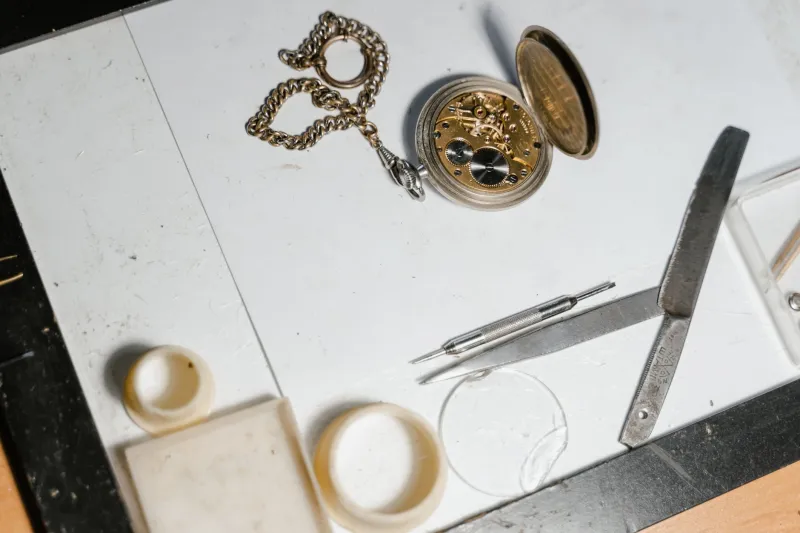
"It's the same mindset as a watch restorer," he says. "You want the repair to be invisible, but you also want to document that it happened. Transparency matters in collector culture."
Faded Art and the Color Matching Rabbit Hole
Perhaps the most technically demanding aspect of CD packaging restoration is dealing with faded or discolored artwork. Prolonged light exposure can bleach printed covers, shifting colors toward yellow or washing out deep blacks. Restoring those colors without making the piece look repainted is an exercise in patience and precision.
Several restorers in the community use a combination of digital scanning, color analysis software, and archival inkjet printing to produce localized touch-up patches — thin printed overlays applied with reversible adhesive, a technique borrowed directly from fine art paper conservation. The goal is always reversibility: a future conservator should theoretically be able to undo what you've done.
"The reversibility principle is huge for me," says Kowalczyk. "I'm not making permanent decisions on someone else's artifact. Everything I do can be undone by someone more skilled than me in the future. That's the ethical standard in conservation, and it applies here just as much as it does in a museum."
A Community Built on Shared Obsession
The network itself is informal but surprisingly organized. A private Discord server called (appropriately) Spine Intact has around 340 members, ranging from total beginners asking how to remove a price sticker without damaging a slipcase to seasoned professionals trading notes on specific adhesive formulations. There's a shared resource library, a buy/sell section for restoration supplies, and a gallery channel where members post their before-and-after work.
The community skews heavily toward people in their 30s and 40s — the generation that grew up buying CDs at Tower Records and FYE, that has a visceral emotional connection to physical music media, and that now has enough disposable income to pursue that connection seriously. Many members are also vinyl collectors, but they tend to argue that CD packaging restoration is actually harder because the materials are less understood and the collector market has historically undervalued the work.
"Vinyl gets all the prestige," says Fontaine. "But try restoring a gatefold digipak with a multi-panel booklet and a slipcase that's been through a flood. That's a three-week project. Nobody writes think pieces about that."
Fair point.
What It Actually Costs to Care
For collectors considering bringing a damaged piece to one of these specialists, the economics are real. A basic jewel case repair — cracked tray, replaced spine card — might run $30 to $60. A full digipak restoration with booklet repair and color touch-up can climb past $300. For truly rare or significant pieces, collectors have reported spending upward of $500 on a single package.
Is it worth it? That depends entirely on what the piece means to you and what the market says it's worth. A first pressing of a major album in poor condition versus excellent condition can represent a price difference of hundreds of dollars on the resale market. More often, though, the collectors commissioning this work aren't thinking about resale at all. They're thinking about what it felt like to hold that album for the first time.
"I have a copy of The Fragile by Nine Inch Nails that I bought at a midnight release in 1999," says Delray. "The box is a little beat up. The booklet has a crease. I'm going to have it restored properly someday, not to sell it — just because it deserves to look the way it did when I first opened it. That's the whole point."
That sentiment, more than any technique or tool, is what holds this community together. These are people who believe that the packaging is part of the music — that the cardboard and plastic and ink are as worth preserving as the audio inside. In a world where most people stream everything and own nothing, that's either crazy or kind of beautiful.
Probably both.