From Shelf to Statement: How CD Cases Became the New Wall Art for Millennial Homes
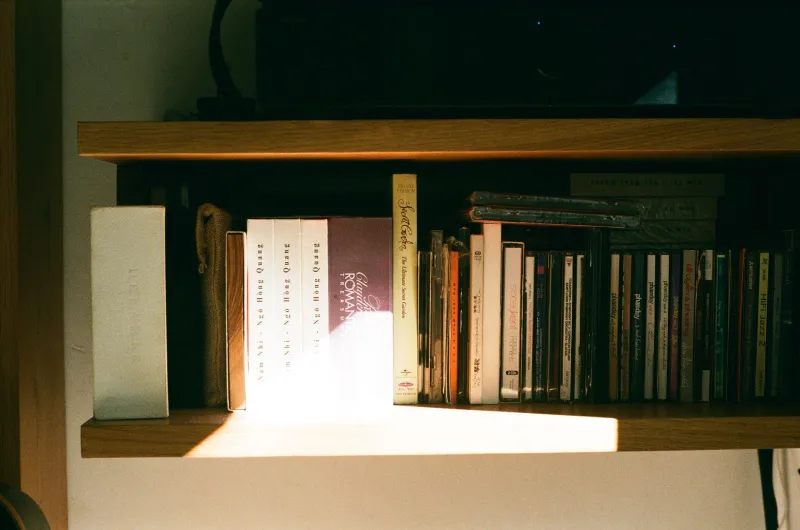
There's a shelf in Priya Nair's Chicago apartment that stops guests mid-conversation. It's not a bookshelf, exactly — though it runs floor to ceiling along one wall of her living room. It's not a record display, either. It's roughly 400 CD cases, arranged by color, mood, and era, lit softly from above like a museum installation. Radiohead bleeds into Björk. Tori Amos gives way to Nine Inch Nails. The whole thing pulses with a kind of low-frequency nostalgia that's hard to name but impossible to ignore.
"People always ask if I'm a DJ," Priya says, laughing. "I'm not. I'm just someone who grew up with these things and couldn't stand the idea of hiding them in a closet."
She's not alone. Across the US, a growing number of millennials are pulling their CD collections out of storage and treating them not as relics of a dead format, but as legitimate design objects — pieces that deserve wall space, lighting, and the same intentional curation you'd give a gallery print or a vintage poster.
The Object That Refused to Disappear
For a format that streaming culture has spent twenty years trying to bury, the CD has a remarkable talent for resurrection. Sales have actually ticked upward in recent years, and while some of that is driven by K-pop fan culture and new releases, a quieter movement is happening in living rooms rather than record stores.
Millennials — the generation that grew up ripping CDs to iTunes and then migrated wholesale to Spotify — are circling back. Not necessarily to listen to CDs, though plenty do. They're coming back to own them. To hold them. To put them somewhere visible.
The psychology here isn't hard to decode. In an era when your entire music library exists as invisible data on a server somewhere in Northern Virginia, there's something almost radical about insisting that music take up physical space in your home. A curated CD shelf is a declaration: this music matters to me enough to give it a room.
"Streaming flattened everything," says Marcus Webb, a graphic designer in Austin who displays about 300 CDs on custom floating shelves in his home office. "Every album looks the same in a playlist. But when you line them up on a wall, you start to see each one as its own thing again. The artwork, the spine text, the thickness of the case — it all comes back."
Design Logic, Not Just Nostalgia
What's interesting about this trend is how deliberately designed these displays are. This isn't your dad's CD tower in the corner of the den. Collectors like Priya and Marcus are thinking like interior designers — considering color blocking, negative space, lighting temperature, and the visual rhythm of spines lined up in sequence.
Color organization is probably the most visually striking approach. When you arrange CDs by the dominant tone of their cover art, the results can look genuinely painterly — a gradient wall that shifts from warm amber through deep blue to black. Albums you'd never pair musically end up side by side because their artwork shares a palette. It creates unexpected juxtapositions that feel more like curation than collection.
Other collectors organize by era, genre, or emotional association. Some go strict alphabetical but use custom shelving to create a grid-like installation that emphasizes the geometry of the jewel case itself. A few have gone even further, removing cases from shelves entirely and mounting individual covers behind glass like framed prints.
"I have three covers matted and framed in my hallway," says Dani Sorenson, a teacher in Portland, Oregon. "My husband thought I was losing it. Now his friends come over and want to know where we bought the art."
The Jewel Case as Design Object
Part of what makes CDs work as display pieces in a way that, say, cassette tapes don't quite manage is the jewel case itself. That hard plastic shell — so often maligned for cracking, for being wasteful, for feeling cheap — turns out to have genuine visual properties when you line up a hundred of them.
The uniform dimensions create a satisfying modularity. The slight transparency of the case lets light interact with the booklet inside. The spine, that narrow strip of text and color, becomes a design element in its own right when multiplied across a full shelf. There's a reason collectors obsess over original pressings with their specific spine fonts and label designs — that inch-wide strip of information is doing a lot of visual work.
Some collectors have started mixing in digipaks and cardboard sleeves specifically for textural contrast — the matte surface of a digipak next to the reflective plastic of a standard case creates a visual texture that a purely uniform display doesn't have. It's the same logic a good bookseller uses when mixing hardcovers and paperbacks on a display table.
What It Signals in a Streaming World
Displaying physical music in 2024 is, whether the collector intends it or not, a kind of cultural statement. It signals an attachment to the tactile, to the permanent, to the idea that music should have a body as well as a soul. It pushes back — gently, aesthetically — against the notion that convenience should be the only value we apply to art.
There's also something deeply personal about a visible music collection in a way that a streaming playlist never quite achieves. Your Spotify Wrapped tells an algorithm what you listened to. Your CD shelf tells a guest who you are. Every purchase you made, every phase you went through, every album that hit you at exactly the right moment — it's all there, physical and permanent, arranged on a wall for anyone who cares to read it.
"My shelf is basically my autobiography," Marcus says. "Someone who knows music can walk along it and figure out a lot about me pretty quickly. That's not something your phone can do."
Starting Your Own Display
If you're thinking about pulling your collection out of the garage, a few collectors offered some practical starting points. Start with a single shelf rather than going wall-to-wall immediately — live with a smaller arrangement for a few weeks to figure out what organization logic feels right to you. Invest in decent lighting; warm LED strips mounted above a shelf can transform the look entirely. And don't underestimate the spine — before you commit to an arrangement, flip through your cases and pay attention to what the spines look like together. That's the view you'll have every day.
Most importantly, don't treat it as a museum. Pull cases out, play them, rearrange. The best CD displays are living things, not frozen archives.
Priya is already planning an expansion into her hallway. She recently picked up a stack of late-90s electronica at a thrift store in Wicker Park — not because she needed the music, but because the covers were too good to leave behind.
"At this point," she admits, "I might be collecting art that happens to have music inside it."
Honestly? That sounds about right.