Hang It on the Wall: Inside the Growing World of Album Art Collected Like Museum Pieces
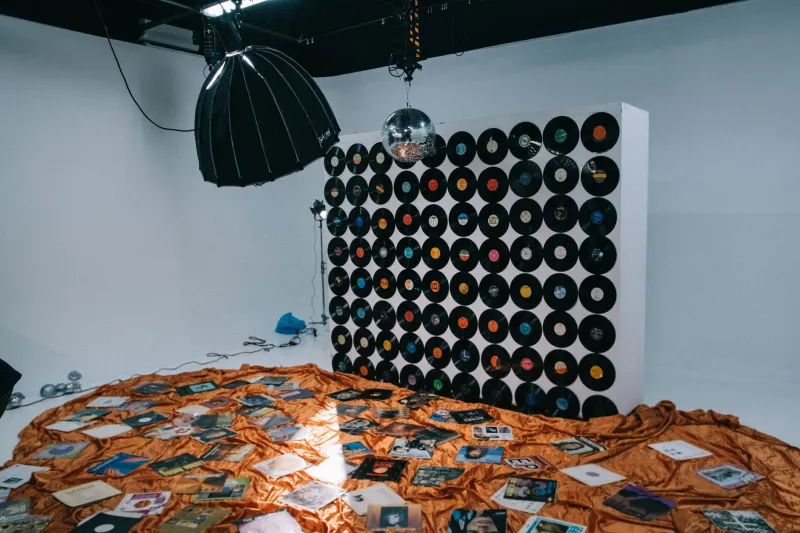
In a spare bedroom of his Philadelphia row house, Marcus Delray has installed museum-quality UV-filtering glass over a framed original promotional poster for Miles Davis's Bitches Brew — the one with the Mati Klarwein painting that looks like a fever dream crossed with a Renaissance altarpiece. Beside it hangs a professionally mounted original pressing of the Velvet Underground's debut, banana and all, inside a shadowbox with archival foam backing. The temperature in the room is kept at a steady 65 degrees.
"People come over and they think I'm being precious about it," Delray says, laughing. "But then they stand in front of the Miles Davis piece for five minutes without saying anything, and I don't have to explain it anymore."
Delray isn't alone. Across the country, a quietly serious community of collectors has begun treating album cover art — not just the records or CDs themselves, but the visual artifacts that came with them — as legitimate objects of fine art collection. Complete with custom framing, controlled environments, documented provenance, and price tags that would raise eyebrows at a contemporary art fair.
When Did a Record Sleeve Become a Collectible?
The short answer is: it's always been one, but nobody was calling it that.
For decades, the instinct to hold onto great album packaging existed mostly in the background — fans who couldn't bring themselves to throw away a gatefold sleeve, record store employees who tacked promotional flats to the wall, DJs who kept their favorite covers out as decoration. It was informal, intuitive, and largely unacknowledged by the art world.
What's changed in the past ten years or so is the formalization of that impulse. Auction houses are now regularly featuring original album artwork — not just the physical paintings or photographs used for covers, but the finished printed artifacts themselves, particularly rare pressings, promotional materials, and artist-signed packaging. Heritage Auctions, one of the largest collectibles auction houses in the US, has seen consistent growth in its music memorabilia categories, with cover art and related materials commanding increasingly serious prices.
Original artwork used for famous covers — think the photograph behind the Beatles' Abbey Road sleeve or the painting commissioned for a classic rock landmark — has always sold well. But the shift now is toward the printed object itself being valued as a collectible in its own right, independent of whether it's a one-of-a-kind original.
The Case for Album Art as Fine Art
It's not a hard argument to make, once you start looking at the actual work.
Some of the most significant visual artists of the twentieth century made their most widely distributed work on album covers. Andy Warhol's banana for the Velvet Underground. Robert Mapplethorpe's photography for Patti Smith's Horses. Peter Saville's design work for Joy Division and New Order, which influenced graphic design far beyond the music industry. Hipgnosis, the British design firm behind iconic covers for Pink Floyd and Led Zeppelin, produced work that hung in the visual culture of an entire generation.
"These images shaped how people understood entire eras," says cultural critic and writer Dana Osei, who has written about the intersection of music memorabilia and contemporary art markets. "The cover of Nevermind is as visually significant as any image from that period. The cover of Purple Rain is a piece of visual communication that defined a moment. Pretending those aren't art objects because they were attached to a commercial product is just snobbery."
That argument is gaining traction in spaces that once would have dismissed it. Small galleries in cities like New York, Los Angeles, and Chicago have begun mounting exhibitions specifically around album cover art — sometimes featuring original design materials, sometimes displaying high-quality reproductions framed and hung with the same care as photography prints. The response, according to gallery owners who've tried it, has been consistently strong.
The Collector's Mindset
People who collect album art seriously tend to fall into a few distinct categories, though there's significant overlap.
There are the purists, who want original pressings in the best possible condition — the kind of collector who understands the difference between a first UK pressing and a US domestic release and will pay accordingly. There are the aesthetes, who care primarily about the visual power of the object and display their pieces the way a photography collector would, with an eye toward how things look together on a wall. And there are the investors, who've noticed that certain pieces have appreciated significantly and are treating the category with the same analytical approach they'd bring to any alternative asset class.
"I look at it like early photography prints," says Renata Villalobos, a Los Angeles-based collector who focuses on original promotional materials from 1970s soul and funk releases. "For decades, people didn't take photography seriously as a collectible art form. Then the market woke up and the prices moved fast. I think we're at an early stage of that same curve with music visual ephemera."
Villalobos has invested in custom framing that she estimates costs more than many of the pieces themselves — archival matting, conservation glass, frames built to museum specifications. "If I'm going to hang it like art, I'm going to treat it like art," she says. "The framing is part of the statement."
The Skeptics Have a Point, Too
Not everyone is convinced that what's happening represents a genuine cultural reappraisal rather than nostalgia inflating prices on things people remember fondly.
"There's a real risk of conflating emotional attachment with aesthetic value," says one art market analyst who asked not to be named. "A lot of what's driving prices in this space is generational sentiment — people who grew up with these records are now in their forties and fifties, they have disposable income, and they're paying for the feeling of connection to their own past. That's legitimate, but it's different from the market dynamics that sustain fine art values over the long term."
It's a fair challenge. The history of collectibles markets is littered with categories that spiked on nostalgia and then corrected sharply when the generation driving demand aged out of active collecting. Whether album cover art has enough genuine cultural staying power to hold value across generations is genuinely uncertain.
But the counter-argument is that the best of this material isn't just nostalgia bait — it's legitimately significant visual culture that has influenced designers, photographers, and artists across disciplines for decades. The work doesn't stop being good because it was commercially distributed.
Where This Is Heading
The trajectory seems clear enough, even if the destination is hard to pin down. More galleries are going to experiment with album art exhibitions. Auction prices for significant pieces are going to keep climbing. A small but growing number of serious collectors are going to keep treating this material with the same rigor they'd bring to any other fine art category.
Whether the broader art world ever fully embraces album cover art as a legitimate fine art category — with all the institutional validation that implies — is another question. But for the collectors hanging their pieces under UV glass in climate-controlled rooms, that validation might be beside the point.
The work is on the wall. It holds up. That tends to be the beginning of most art historical arguments, not the end of them.