Chasing Cover Art: How a Handful of Devoted Americans Are Spending Fortunes to Own Music History
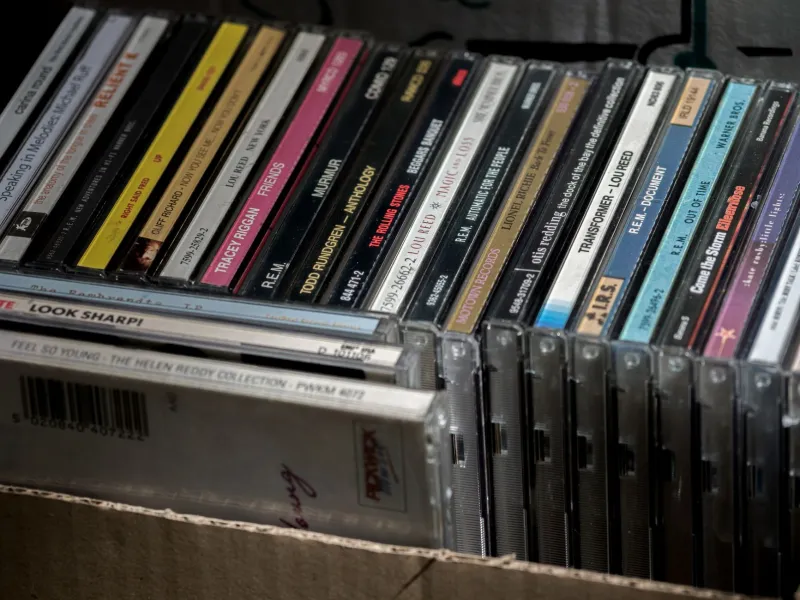
There's a storage unit in suburban Phoenix, temperature-controlled and padlocked, that contains more music history than most public libraries. Its owner, a 54-year-old former graphic designer named Marcus Webb, doesn't have a band name on the door or a catalog number stenciled on the wall. What he has is shelf after shelf of meticulously archived CDs — over 11,000 of them — each stored spine-out in acid-free sleeves, organized by designer rather than artist.
"Most people collect by genre or decade," Marcus says, running a finger along a row of early-90s releases. "I collect by who made the art. I've got entire sections dedicated to Storm Thorgerson's work, to Hipgnosis output, to sleeve designers most people have never heard of. The music is almost secondary at this point."
Marcus is part of a surprisingly robust underground community — serious collectors who have poured enormous sums into physical media at a moment when the rest of the world has largely moved on to streaming playlists and algorithm-generated radio. And they're not slowing down.
The Price of Obsession
When people hear that a single CD can command thousands of dollars at auction, they tend to assume something went wrong. But in the collector market, rarity and visual significance drive prices in ways that feel completely rational once you understand the culture.
A first pressing of Prince's Black Album — the infamous 1987 release that was pulled from shelves just days before distribution — has sold for upward of $4,000 in near-mint condition. Early Japanese pressings of certain Pink Floyd titles, with their distinct obi strips and alternate liner notes, routinely clear $500 to $800 on eBay and Discogs. And when it comes to promotional copies, test pressings, or region-specific variants with unique artwork, the ceiling essentially disappears.
Recent auction records tracked by collector communities suggest that assembled libraries of significant releases — when sold as curated lots — have fetched totals well into the five-figure range. A 2022 Heritage Auctions sale that included signed artwork proofs and original photography from iconic album shoots cleared over $60,000 across the lot. The physical artwork, not the music itself, was the draw.
"People keep saying physical media is dead," says Diane Kowalski, who runs a small but respected CD resale operation out of her home in Cleveland. "But I've never been busier. The people who care about this stuff really care about it. They're not casual buyers."
What Makes a Cover Worth Chasing
Not every album cover is created equal in the collector's eye, and understanding what separates a $12 used CD from a $1,200 grail requires a crash course in design history, pressing geography, and cultural timing.
First and foremost, there's the artwork itself. Covers that broke visual conventions — think the stark minimalism of Joy Division's Unknown Pleasures, the surrealist sprawl of Yes's Tales from Topographic Oceans, or the deliberately provocative imagery of early hip-hop releases — carry a kind of cultural weight that appreciation compounds over time. Collectors aren't just buying a disc; they're buying a document of a moment when someone decided to take a creative risk.
Then there's the question of format variants. The CD era, spanning roughly 1982 through the mid-2000s, produced an almost overwhelming variety of regional pressings, limited editions, longbox formats (those tall cardboard packages used in early US retail), digipaks, and slipcase editions. Each variant can carry different artwork, different liner note photography, or subtle color variations in the printing that make them distinct objects.
Longboxes are a particular obsession among American collectors. Designed to fit standard retail display racks built for vinyl, these tall cardboard sleeves were used almost exclusively in the US market from the late 1980s through the early 1990s. When they were discontinued for environmental reasons, most were simply thrown away — which makes surviving examples, especially sealed ones, genuinely scarce.
"A sealed longbox of Nirvana's Nevermind in excellent condition? You're looking at several hundred dollars minimum," says Marcus. "Not because the music is rare. Because that object, in that form, basically doesn't exist anymore. And it's beautiful. The artwork reads differently at that size."
The Community Behind the Collection
What's striking about this world is how social it is. Despite the stereotype of the solitary collector hoarding treasures in a basement, the serious CD community in the US is remarkably connected — through Discord servers, dedicated subreddits, regional meetups, and long-running forums where members post want lists and trade leads on upcoming estate sales.
Diane describes a network of "scouts" — people who hit thrift stores, garage sales, and library discard bins in specific geographic areas and flag interesting finds to collectors they know are looking. "I've got a guy in Portland who texts me photos of anything he finds with original longbox packaging. I've got someone else in Nashville who specializes in country and Americana pressings from small regional labels. It's a whole ecosystem."
There's also a generational handoff happening in real time. As older collectors downsize or pass away, their libraries enter the market — sometimes through estate sales where the family has no idea what they're sitting on, and sometimes through deliberate, carefully negotiated sales to collectors who can appreciate what they're acquiring.
"I bought a collection last year from a family in Michigan," Marcus recalls. "The guy had passed away and his kids just wanted it out of the house. There were first-edition promotional copies in there from labels that don't exist anymore, with cover artwork that never made it into the standard retail release. I paid a fair price, but I also felt like I was rescuing something."
Why Now?
It might seem counterintuitive that interest in physical CDs is intensifying at the exact moment when streaming has made the music itself essentially free and universally accessible. But collectors will tell you that's precisely the point.
When the music lives in the cloud, the artifact becomes the thing. The disc, the case, the liner notes, the artwork — these are the physical proof that a creative act happened, that humans made decisions about color and composition and typography to represent something intangible. In a world of infinite playlists, a well-designed jewel case is a small act of resistance.
For Marcus, the mission is almost archival. "These objects tell you something about the culture that made them," he says, gesturing at the rows of spines in his storage unit. "Fifty years from now, someone's going to want to know what a CD actually looked like, felt like, smelled like when you opened it. I want to make sure those things still exist."
That might sound grandiose for a guy standing in a climate-controlled storage unit in Phoenix. But walk through the stacks with him for a while, pulling out covers and hearing the stories attached to each one, and it starts to feel less like obsession and more like preservation.
The music streaming services will keep the songs alive. Marcus and collectors like him are keeping everything else.